Legal Information
& History
XII. PETITIONER’S CONSTITUTIONAL INTEGRITY AND AMERICAN SERVICE
This case is about protecting innocent Americans and upholding the Constitution when it matters most. Petitioner Muhammad Zahid Chaudhry was repeatedly pressured by federal intelligence agencies—including the FBI and other OGAs—to become complicit in the surveillance, targeting, and “terrorist” framing of innocent Americans during the chaotic post-9/11 period. As sworn under penalty of perjury by the only other contemporary witness, Ann Chaudhry, in her affidavit (Ex. 101), that pressure was not limited to a single inquiry or a good-faith request. It began within weeks of 9/11, unfolded over years, and took the form of persistent approaches, coercive “carrot-and-stick” maneuvering, and aggressive retaliatory harassment after Petitioner refused to comply.
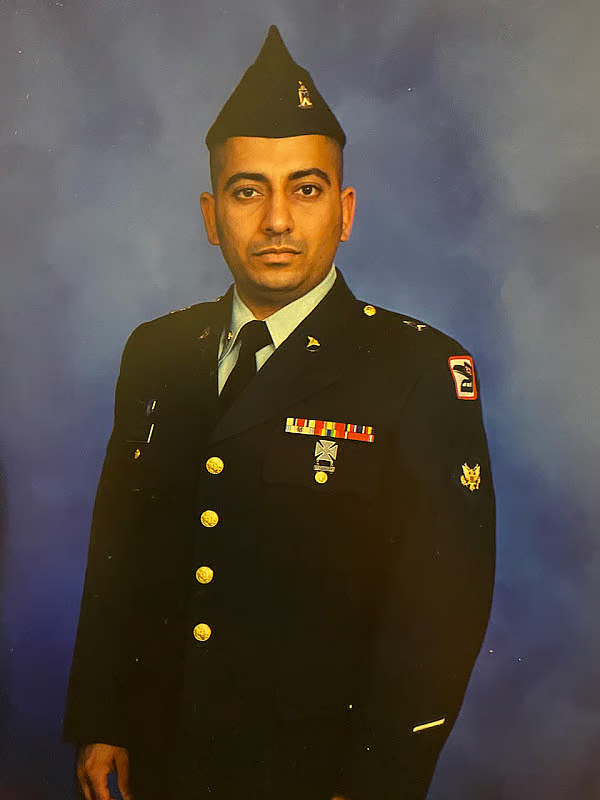
Critically, this was not a situation in which the government sought legitimate information about an actual threat to life, limb, or property. Had Petitioner possessed such information, he would have considered it his constitutional, civic, and moral duty to convey it. He has always done the right thing, and the record reflects a lifetime of lawful conduct, public service, and integrity—including his astonishing perseverance in pursuing remedies for his mistreatment, invoking no grounds of eligibility other than his military service, and seeking only what he has duly earned. The extraordinary pressure applied to compel his compliance arose precisely because there was no legitimate basis for the demands being made—demands that sought not the honest prevention of genuine danger, but compliance with practices that treated the Constitution as optional and suspicion as a career-advancing tool.
Petitioner’s refusal arose not out of defiance, but out of principle. He understood that the Constitution he had sworn to protect as an American soldier forbids unlawful search and seizure, collective suspicion, and the targeting of communities without cause. He understood that loyalty to country does not mean obedience to unlawful or corrupt demands, but fidelity to the rule of law. In declining to participate, Petitioner protected and upheld the Fourth Amendment rights of innocent Americans and the foundational premise that government power must be constrained by law.
That choice has carried an extraordinary and prolonged price. Petitioner’s path to citizenship has been cruelly and continuously held in abeyance—used as leverage to compel his cooperation. As the record reflects, his refusal was followed by his unlawful designation under CARRP (Ex. 130; Ex. 151), resulting in the institutional obstruction and bureaucratic persecution now before this Court, as well as years of surveillance, intimidation, and harassment of himself, his family, friends, and former neighbors that persisted into at least 2019 (Ex. 101).
The prime years of his life have been stolen—consumed by suspicion rather than recognition, delay rather than due process, and exclusion rather than full membership in the civic community he served. He lost years of security, status, and opportunity. He was denied the right to vote, to run for office, and to fully participate in the democratic life of his country—not because of misconduct, but because of integrity.
This is not a tale of special pleading. It is a story as old as the Republic: whether the law will protect those who stand on principle when power presses hardest and expedience tempts corruption. The Constitution is not self-enforcing; it depends on courts to give it life. When an honorable American veteran is punished for protecting innocent Americans, refusing coercion, and adhering to constitutional limits, judicial intervention is not only permitted—it is required to remedy precisely this kind of manifest injustice.
Legal Documents:
Powered By EmbedPress
Powered By EmbedPress
Additional Legal Documents:
Powered By EmbedPress
Powered By EmbedPress